Uncategorized

5 Signs Your Website Is Secretly Losing You Customers Every Single Day

5 Signs Your Website Is Secretly Losing You Customers Every Single Day Most business owners think of their website as a digital brochure. You build it once, it exists, and it does its job by simply being there. The reality in 2026 is very different. Your website is either your best salesperson or your worst liability. There is very little middle ground. The uncomfortable truth is that a poorly performing website does not just fail to win customers. It actively sends them to your competitor. Someone lands on your page, something frustrates them within a few seconds, and they leave. They do not email you to explain why. They do not call to say they had a bad experience. They just go. And they usually end up somewhere else. Here are the five signs that your website is doing this to you right now, and what to do about each one. Sign 1: Your Website Takes More Than Three Seconds to Load Three seconds sounds like nothing. But in the context of online behaviour it is an eternity. Research consistently shows that over half of all website visitors will leave a page if it has not loaded within three seconds. On mobile that number is even higher. Every second of load time that you remove translates directly into a higher percentage of visitors who stay on your page instead of bouncing straight back to Google. That means more leads, more enquiries and more revenue from exactly the same number of visitors. Slow load times are usually caused by images that have not been compressed, too many plugins running on a WordPress site, poor quality hosting, or code that has not been optimised. All of these are fixable. Nabeel from Agenterhub UK checks page speed as the very first step on every website audit: “It does not matter how good your content is or how much you have spent on design if the page loads in seven seconds. Google uses load speed as a ranking factor and visitors use it as a trust signal. A slow website says something unflattering about the business behind it, even if that is completely unfair.” You can test your own website speed right now using Google PageSpeed Insights. If your mobile score is below 60, this is your most urgent problem to fix. Sign 2: Your Website Does Not Work Properly on Mobile This one still surprises people. In 2026 the majority of website traffic comes from mobile devices. Across most industries in the UK, mobile accounts for between 55% and 70% of all visits. If your website was built more than four years ago without a specific focus on mobile experience, there is a strong chance it is broken for more than half the people visiting it. Mobile problems range from obvious to subtle. Text that is too small to read without zooming. Buttons that are too close together to tap accurately. Images that spill off the side of the screen. Forms that do not work when filled in on a phone. Phone numbers that are not clickable to call directly. Every one of these friction points is a reason for a visitor to leave. And visitors who leave because of a bad mobile experience rarely come back. Juned Ali at Agenterhub UK sees this regularly across new client websites: “We will audit a site and find that on desktop it looks completely fine. Clean, professional, well laid out. Then we switch to mobile view and it falls apart. Menus that do not open, text sitting on top of images, a contact form with fields that are impossible to fill in on a touchscreen. That business has been losing mobile customers silently for years without even knowing it.” Sign 3: There Is No Clear Call to Action Above the Fold Above the fold means the part of the page a visitor sees without scrolling. It is prime real estate and most websites waste it completely. A visitor arrives at your website with a problem they want solved. They have approximately five to eight seconds to decide whether they are in the right place and what to do next. If your page does not clearly tell them what you do, who you do it for and what they should do next all within that visible area, you have lost them. A clear call to action does not need to be complicated. A visible phone number. A button that says “Get a free quote today.” A simple form with two fields. Something that gives the visitor an obvious frictionless next step without requiring them to scroll, search or think. Look at your homepage right now on your phone without scrolling. Is it completely obvious what your business does and how to contact you? If you have to scroll to find the answer, that is a conversion problem. Sign 4: There Are No Trust Signals Anywhere to Be Seen When someone visits your website who has never heard of you before, they are making a rapid unconscious assessment of whether you are trustworthy. This happens in seconds and it happens before they have read a single word of your content. Trust signals are the elements that tip that assessment in your favour. Customer reviews and testimonials with real names and specific outcomes. Case studies showing actual results. An About page with real photographs of real people. Industry accreditations or memberships. A physical address and a local phone number. A clear privacy policy. The absence of these signals does not make a visitor think neutrally about your business. It makes them feel uncertain and uncertainty sends people back to Google. The businesses winning customers online in 2026 have made trust visible throughout their website. It is not buried on an inner page. It is woven into the homepage, the service pages and every touchpoint a visitor might land on. Sign 5: Your Content Talks About You Instead of Your Customer This is the most common website mistake

5 Signs Your Website Is Secretly Losing You Customers Every Single Day Read More »
SEO vs Google Ads for UK Small Businesses in 2026: Which Comes First?

SEO vs Google Ads in 2026: Which One Should a UK Small Business Invest in First?

SEO vs Google Ads in 2026: Which One Should a UK Small Business Invest in First? This is the question that comes up in almost every first conversation we have with a new client. You have a marketing budget. It is not unlimited. You know you need to be more visible online. But every time you try to research whether to go with SEO or Google Ads first, you end up reading articles written by agencies who conveniently recommend whichever one they happen to specialise in. So here is an honest answer. No agenda. No hidden pitch. Just the actual framework you need to make the right decision for your specific business in 2026. What SEO Actually Means in 2026 Search engine optimisation is the process of improving your website and online presence so that Google shows you to people who are searching for what you offer, without you paying for every click. In 2026 this is more sophisticated than it has ever been. It is not about stuffing keywords into a page. It covers technical performance, content quality and depth, the authority and relevance of websites linking to you, user experience signals, local search optimisation including your Google Business Profile, and how well your content actually answers the questions people are asking. The defining characteristic of SEO is that it takes time to build but the results are durable. A page that earns a strong ranking can continue generating traffic and leads for years with relatively modest ongoing maintenance. The investment is front-loaded but the return compounds over time. Nabeel, lead SEO specialist at Agenterhub UK, puts it in terms most business owners find useful: “Think of SEO like buying a property. There is an upfront cost, it takes time to see the full value and it requires maintenance. But once you own it, it generates returns without requiring you to keep paying rent to appear. Google Ads by contrast is renting. The moment the rent stops, you disappear.” What Google Ads Actually Means in 2026 Google Ads, also known as pay per click advertising, allows you to pay to appear at the top of Google search results for specific keywords. You set a budget, choose your keywords and pay each time someone clicks your ad. The defining characteristic of Google Ads is speed. A properly set up campaign can have you appearing at the top of Google within 24 to 48 hours. There is no waiting for rankings to build. No months of content creation. You set the budget, target the right searches and the traffic starts immediately. The trade-off is that the moment your budget stops, so does all of that visibility. You are not building anything that continues to work without investment. You are buying traffic one click at a time. Google Ads in 2026 is also significantly more competitive than it was five years ago. Cost per click has risen in most industries. Getting a strong return requires genuine expertise in campaign structure, keyword targeting, ad copy, landing page quality and bid strategy. A poorly managed campaign can burn through a budget very quickly with very little to show for it. The Case for Starting With SEO If your business has a medium to long term mindset and can sustain a period of six to twelve months before seeing significant organic results, SEO is almost always the stronger first investment for these reasons. The results you build are owned, not rented. Every position earned through SEO continues to generate value even if you reduce investment temporarily. Over a three to five year horizon, the cost per lead from organic search is consistently lower than from paid advertising in almost every industry. SEO also builds credibility in a way paid ads cannot. Organic results are trusted more by searchers than paid placements. A business ranking organically is perceived as earning its position. For local businesses in Derby, Derbyshire and Birmingham, local SEO in particular offers strong results because competition is concentrated to a specific geographic area. Ranking for “commercial cleaning company Derby” is significantly more achievable than ranking for “commercial cleaning company UK.” The Case for Starting With Google Ads If your business needs leads quickly, if you are launching something new and need to test the market, or if your product or service has a very short sales cycle with a high conversion value, Google Ads is often the right starting point. It is also the right choice when you need data. Running Google Ads tells you which keywords actually convert, what your cost per lead is in reality, and which landing pages perform. This data is incredibly useful for informing your SEO strategy. Juned Ali makes this point clearly: “Some businesses come to us and they genuinely cannot wait nine months for SEO to build momentum. They need enquiries this month. In those cases, Google Ads is the right answer for the short term while we build the organic foundation alongside it. The two are not mutually exclusive.” When to Run Both Together The strongest position a business can be in is running both simultaneously. This is not always possible from day one due to budget constraints but it should always be the direction of travel. When you appear in both the paid results and the organic results for the same search, click through rates increase significantly. Seeing a business name twice on the same page builds rapid familiarity and trust. The paid ads generate immediate leads while the organic rankings build long term equity. The Decision Framework Here is a simple way to decide based on your situation. If your monthly marketing budget is under £1,000, focus it on SEO with a strong local content strategy. The compound return over 12 to 18 months will outperform the volume of paid traffic that budget could generate. If your budget sits between £1,000 and £2,500 per month, split it with approximately 60% toward SEO and 40% toward Google Ads to generate leads while the

SEO vs Google Ads in 2026: Which One Should a UK Small Business Invest in First? Read More »

Have you noticed your competitor appearing on Google while your business stays invisible?

Why Your Competitors Are Getting All the Leads and What They Are Doing That You Are Not

Why Your Competitors Are Getting All the Leads and What They Are Doing That You Are Not There is a specific kind of frustration that every business owner knows. You have been trading for years. You know your product or service is genuinely good. Your existing customers are happy and they come back. But somehow, when you search for what you do on Google, your competitor appears first. Their phone rings. Their inbox fills up. And you sit there wondering what on earth they are doing differently. The answer is rarely luck. It is almost never a better product. In the vast majority of cases it comes down to one thing: they made a deliberate decision to invest in their digital presence before you did, and that head start is now paying them every single month on autopilot. The good news is that a head start is not a permanent advantage. Understanding exactly what they are doing is the first step to catching them and then overtaking them entirely. They Showed Up on Google Before You Did The single most common reason a competitor is getting more leads online is that they started SEO earlier. That is it. Search engine optimisation takes time to build momentum, but once it does the results compound in a way that almost nothing else in marketing does. Every month a competitor has invested in SEO and you have not is a month of ground that needs making up. Their pages have been indexed, assessed and gradually moved up the rankings. They have content Google trusts. They have links pointing to their site from relevant sources. They have a track record. Nabeel, lead SEO specialist at Agenterhub UK, explains what this looks like in practice: “When we audit a business and compare it to a stronger local competitor, the difference is almost always time and consistency. The competitor started 12 to 18 months earlier, kept going even when results were slow, and now they are sitting in positions that take real effort to shift. It is not magic. It is patience with the right strategy behind it.” The businesses winning the local search results in Derby, Birmingham and Derbyshire right now did not get there overnight. They got there because someone made a decision and stuck with it. Their Google Business Profile Is Actually Doing Its Job Open Google right now and search for your service in your town. Look at the three businesses that appear in the map section at the top of the results. Those businesses are getting a significant share of all the clicks and calls generated by that search every single day. Google Business Profile is one of the most underutilised tools available to UK small businesses. Most businesses claim their profile, add a phone number and a few photos and then forget it exists. The businesses dominating that map section are doing something very different. They are posting regularly. They are responding to every review. Their categories are set correctly. Their service areas are defined. Their Q and A section is populated. They have hundreds of consistent reviews with detailed responses to each one. This is not complicated work but it is consistent work and most businesses simply do not do it. Your competitor probably is. They Are Running Paid Advertising Alongside Their Organic Strategy While you are waiting for organic results to build, your competitor may well be running Google Ads or Meta Ads at the same time. Paid advertising does not replace SEO but it fills the gap while organic rankings develop and continues to add volume once they do. Juned Ali, Managing Director at Agenterhub UK, sees this pattern constantly: “The businesses growing fastest online are almost never relying on a single channel. They are doing SEO for long term compounding results, running Google Ads to capture people who are searching right now and using Meta Ads to stay visible and build brand awareness with their local audience. It is not always about spending more. It is about spending intelligently across the right combination of channels.” If your competitor appears in the organic results and the paid results and the map section all at the same time, they are capturing an enormous share of all available clicks for that search. A buyer who sees the same business name in three different places on the same page is far more likely to trust them and click. Their Website Converts Visitors Into Enquiries Here is something most business owners do not consider. Even if you managed to drive exactly the same number of visitors to your website as your competitor, they might still win more customers simply because their website converts better. Conversion is the process of turning a visitor into an action. A phone call. A form submission. A booking. A quote request. The difference between a website that converts at 2% and one that converts at 5% is enormous when you multiply it across hundreds of monthly visitors. The things that drive conversion are not complicated but they do require attention. Is there a clear phone number visible on every page without the visitor needing to scroll? Does the page load in under three seconds? Is there a simple obvious call to action above the fold? Are there testimonials and reviews visible before the visitor has to go looking for them? Is the website easy to navigate on a mobile phone? Businesses with higher converting websites win more customers from the same traffic without spending a single additional pound on advertising. They Are Publishing Content That Builds Trust Over Time Your competitor with the blog that gets updated regularly is not just getting SEO benefits from that content. They are also building something that takes time to establish and is very hard to replicate quickly: trust. When a potential customer reads four or five helpful articles from a business before making a purchasing decision, they arrive at the conversation already warm. They feel like they know

Why Your Competitors Are Getting All the Leads and What They Are Doing That You Are Not Read More »

Hiring a digital marketing agency in the UK? Ask these 10 questions first. Agenterhub UK reveals what good answers look like and what red flags to walk away from.

How to Choose a Digital Marketing Agency in the UK: 10 Questions Every Business Owner Must Ask Before Signing Anything

Choosing the wrong digital marketing agency does not just waste money. It wastes time, kills momentum and in some cases puts business owners off marketing altogether for years. That is a problem we see more than we should. The UK is flooded with agencies right now. Some are brilliant. Many are average. A handful will take your money, send you a confusing report every month and quietly hope you do not ask too many questions. This guide gives you exactly what you need to separate the ones worth hiring from the ones worth avoiding. Ten questions, asked in the right order, will tell you almost everything. Why Most Businesses Pick the Wrong Agency The most common mistake is treating the selection process like a price comparison. You get three quotes, pick the middle one and hope for the best. The problem is that price tells you almost nothing about quality, strategy, transparency or whether this particular agency actually understands your industry. Juned Ali, Managing Director of Agenterhub UK, has heard the same story from new clients more times than he can count. “A business owner spends six months with an agency that looked good on paper, pays every invoice on time, and then one day realises they have never once received a phone call to discuss actual results. No leads tracked, no revenue attributed, just a PDF with some graphs that nobody explained. That is not marketing. That is a subscription to the illusion of marketing.” Asking the right questions before you sign changes everything. The 10 Questions to Ask Every Agency Question 1: Can you show me results you have achieved for businesses similar to mine? This is the single most important question you will ask. Any agency worth working with can point you to real outcomes for real clients. Not vanity metrics like impressions or follower counts. Actual leads, enquiries, revenue growth or ranking improvements tied to measurable business impact. If the answer involves a lot of NDAs and vague references to “brands we have worked with,” keep your guard up. Question 2: Who specifically will be working on my account? Many agencies win business with their senior team and then hand the work to a junior executive who started three months ago. Ask directly. Will the person presenting to you today be the one executing the strategy? If not, who will and what is their experience? At Agenterhub UK, every SEO campaign is led by Nabeel personally. Clients know who is doing the work and can speak to them directly. That level of accountability should not be unusual but in the agency world it often is. Question 3: How do you measure success and what does your reporting look like? Ask to see a sample report from an existing client with the client details removed. A good agency report tells you what happened, why it happened and what is happening next. It connects activity to outcomes. A bad one lists tasks completed and leaves you to figure out whether any of it mattered. If the report is full of traffic numbers but never mentions leads or revenue, that is a red flag. Question 4: What is your approach to understanding my business before starting work? Before any agency builds a strategy, they need to understand your customers, your competition, your margins and what a good result actually looks like for you. If an agency skips this step and moves straight to a package recommendation, they are selling you something generic. The onboarding process should feel like an interview. They should be asking you more questions than you are asking them. Question 5: How long before I should expect to see results? This question is about honesty as much as timelines. SEO takes time. A credible agency will tell you that clearly, explain what the first 90 days will focus on, and set realistic expectations. An agency that promises page one rankings in 30 days is either lying or planning to use tactics that will damage your site long term. Google Ads can deliver results faster. Content marketing takes longer. Knowing the difference matters for planning your budget. Question 6: Do you work with businesses in my industry or location? Local knowledge is genuinely valuable. An agency that has already built SEO campaigns for Derby industrial companies or Birmingham SMEs understands the local search landscape in a way that a generalist agency sitting in a London office simply cannot replicate without a significant learning curve. Juned Ali built Agenterhub UK specifically to serve businesses in Derby, Derbyshire and Birmingham because local expertise translates into faster results and smarter strategy. That focus matters. Question 7: What happens to my assets if we stop working together? You would be surprised how many businesses discover their website, their Google Ads account or their content is technically owned by the agency when the relationship ends. Before you sign, confirm in writing that your website files, your ad accounts, your analytics access and your content all belong to you. No exceptions. Question 8: How do you stay current with algorithm changes and platform updates? Google updates its algorithm hundreds of times a year. Meta changes its ad platform constantly. An agency that is not actively investing in education and testing is operating on knowledge that is already out of date. Ask what they have changed in their approach in the last six months. A good answer will be specific. A bad answer will be generic. Question 9: What does your contract look like and what is the exit clause? Long contracts with punishing exit terms are a sign that an agency lacks confidence in its own retention through results. A confident agency offers fair contracts because they know clients stay when the work is working. Ask for a rolling monthly agreement or a clear performance review at the three month mark. If an agency pushes back hard on this, take note. Question 10: Can you explain your strategy for my business in

How to Choose a Digital Marketing Agency in the UK: 10 Questions Every Business Owner Must Ask Before Signing Anything Read More »

a clean flat design infographic illustra rj2blyqfusu9tt9jvdbvbq vrz00tloth6mnyemnofukq cover sd

How Much Does Digital Marketing Cost for a UK Small Business in 2026?

How Much Does Digital Marketing Cost for a UK Small Business in 2026? By MD Juned Ali, Managing Director, Agenterhub UK | SEO reviewed by MD Abdul Muhaimin (Nabeel), Lead SEO Specialist If you have typed this exact question into Google at some point this week, you are genuinely not alone. Thousands of UK small business owners search for this every single month, and most of them close the browser tab feeling more confused than when they started. Vague price ranges, suspiciously cheap promises, and agency websites that list everything except an actual number. So this is the guide we wish existed. No fluff, no bait and switch. Just an honest breakdown of what digital marketing actually costs in the UK in 2026, what you get at each level, and how to make sure your budget is going in the right direction. Why Prices Look So Wildly Different Before we get into numbers, you need to understand why someone can quote you £99 a month for SEO and another agency quotes £1,500 for the same thing. These are not the same product wearing the same label. A solo freelancer updating a few page titles and a specialist team running structured campaigns with monthly reporting, technical audits, content creation and real attribution tracking are two completely different propositions. The danger for small business owners is treating digital marketing like a commodity and choosing entirely on price. Juned Ali, Managing Director at Agenterhub UK, puts it simply: “When a business asks me how much SEO costs, I always ask them one question first. What does a single new client mean to your business? If one new client is worth £4,000 to you, spending £800 a month to bring in three of them is not a cost. It is one of the best decisions you will ever make.” That reframe matters more than any price table. What Each Service Actually Costs in 2026 SEO (Search Engine Optimisation) Monthly SEO retainers for local UK businesses typically sit between £400 and £1,200 per month. National campaigns or highly competitive industries start from around £1,500 and move upward depending on scope. At the lower end you are getting basic onpage optimisation, some content work and light link building. At the higher end you are getting a full technical audit, consistent original content, meaningful link acquisition and proper monthly reporting you can actually understand. Nabeel, lead SEO specialist at Agenterhub UK, has built campaigns for businesses across Derby, Birmingham and Derbyshire covering everything from industrial refrigeration companies to commercial pressure washing services. His take is worth hearing: “Local businesses often underestimate how much work goes into genuine SEO in 2026. It is not keywords on a page any more. It is topical authority, technical health, user experience and content that genuinely serves the reader. Done properly, the results compound. The rankings you build this year are still delivering enquiries two years from now.” Google Ads (Pay Per Click) Google Ads costs come in two parts. The agency management fee and the ad spend itself. Management fees in the UK in 2026 typically run between £350 and £900 per month depending on campaign complexity. Ad spend sits on top of that entirely. For a local small business wanting meaningful results, a realistic monthly ad spend sits somewhere between £500 and £2,000. Below that threshold, the data volume is usually too thin to optimise properly. The real advantage of Google Ads is speed. You can be at the top of search results within days. The challenge is sustainability because the moment you stop spending, the results stop too. This is why most businesses that are growing use both SEO and ads in combination once the budget allows. Meta Advertising (Facebook and Instagram) Meta Ads management fees in the UK generally range from £300 to £800 per month, with a recommended minimum ad spend of around £500 to £1,500 per month to generate consistent results. Meta is particularly strong for reaching local audiences, retargeting people who have already visited your website, and building brand awareness at a comparatively low cost per impression. For Birmingham businesses especially, the Agenterhub team has seen strong results using Meta alongside Google Ads. The two channels complement each other in ways neither can achieve alone. Social Media Management Professionally managed social media where an agency handles content creation, scheduling and community engagement typically costs between £400 and £1,000 per month in the UK. It is worth being realistic about what organic social can and cannot do in 2026. Reach without paid support is limited. Where it excels is trust building, staying visible to warm audiences, and providing social proof for potential clients who are already aware of you. It works brilliantly alongside paid advertising, not as a replacement for it. Website Design and Development A professionally built small business website in the UK in 2026 costs between £1,500 and £6,000 as a one-off project. More complex builds involving ecommerce, booking systems or custom functionality sit between £5,000 and £15,000. If someone is quoting you £299 for a complete website, ask a lot of questions. A poorly built site will actively lose you customers regardless of how much you spend on advertising to drive traffic to it. A Realistic Budget Framework Here is how to think about your budget based on what you actually have available. Around £800 to £1,200 per month: Put the majority of this into one channel and do it properly. Local SEO with a solid content strategy is usually the strongest starting point because the results are cumulative and keep working after the initial investment. £1,500 to £3,000 per month: You can now combine two channels effectively. SEO paired with either Google Ads or Meta Ads is a natural combination depending on your industry and where your customers spend their time. £3,000 and above: This is where a proper multi-channel strategy becomes possible and where growth tends to accelerate noticeably. You are no longer choosing between channels and can let each

How Much Does Digital Marketing Cost for a UK Small Business in 2026? Read More »

How to Write LinkedIn Messages That Convert in B2B

How to Write LinkedIn Messages That Convert in B2B

How to Write LinkedIn Messages That Convert in B2B November 16, 2025 | By Agenterhub Team How to Write LinkedIn Messages That Convert in B2B In the bustling world of B2B networking, LinkedIn stands out as a goldmine for connecting with decision-makers, especially for firms in places like Scunthorpe where local ties matter. But firing off generic notes won’t cut it – you need messages that grab attention, build rapport, and nudge towards deals. With the platform’s user base growing and algorithms favouring genuine chats, getting this right can transform your outreach. This guide shares straightforward steps to craft messages that turn prospects into partners, drawing on proven tactics that fit today’s fast-paced scene. As we hit 2025, trends like AI-driven personalisation and quick video snippets are reshaping how B2B pros message. For Scunthorpe businesses, from steel suppliers to service firms, these approaches can help stand out in a crowded inbox. Agenterhub, a digital marketing agency rooted in Scunthorpe, has guided many local outfits to refine their LinkedIn game, leading to more meetings and sales. Understanding Your B2B Audience on LinkedIn Before typing a word, get inside your recipient’s head. B2B buyers on LinkedIn are busy execs solving company woes, not casual scrollers. Research their profile – job role, recent posts, shared connections – to spot pain points like cost cuts or growth hurdles. In Scunthorpe’s industrial vibe, a supplier might target factory managers facing supply chain snags. Industry reports note that tailored messages see higher open rates, as they feel relevant rather than random. This builds trust from the off. Practical tip: Spend five minutes per profile. Note a recent achievement or challenge they’ve mentioned, then weave it in. Agenterhub advises starting with a list of 20 prospects weekly, focusing on those active in local groups like North Lincs business networks. Crafting a Compelling Subject Line Your subject line is the gatekeeper – make it snappy and intriguing to boost opens. Aim for under 50 characters, hinting at value without giving it all away. Questions or teasers work well, like “Quick Fix for Your Supply Chain Woes?” According to industry reports, personalised subjects lift response rates by standing out in cluttered inboxes. Avoid salesy vibes; think helpful instead. Example: For a Scunthorpe tech firm, “Boosting Efficiency in Steel Ops?” could hook a manufacturer. Test variations – Agenterhub runs A/B checks for clients, often seeing 20% more opens with tweaks. Keep it mobile-friendly, as most LinkedIn checks happen on phones during commutes. Personalising Your Message for Impact Generic blasts flop; personal touches win. Start with their name and a nod to something specific, like “Saw your post on sustainable manufacturing – spot on for Scunthorpe’s scene.” Keep it short – under 150 words – and conversational, like chatting over coffee. Industry practices stress finding common ground, such as mutual contacts or shared interests, to warm things up. Scenario: A local consultant messaged a retailer mentioning their recent expansion, leading to a chat about partnership. Tip: Use LinkedIn’s search for shared alumni or groups – it adds authenticity without creepiness. Agenterhub helps Scunthorpe firms automate light personalisation, blending tools with human flair for natural feels. Highlighting Value Right Away Don’t bury the lead – show what’s in it for them early. Focus on one key benefit or insight that solves a problem, like “Our tool cut downtime by half for similar firms here in North Lincs.” Value-first approaches, a hot trend in 2025, prioritise helping over selling. Back it with a quick stat or story, but keep it light. Time savings for busy pros. Cost reductions in tight markets. Growth ideas tailored to local needs. Real case: A Scunthorpe agency shared a free tip on lead gen, sparking a demo request. Agenterhub crafts these value hooks based on client data, turning messages into magnets. Including a Clear Call to Action End with a simple ask – no ambiguity. Suggest a quick call, reply with thoughts, or share a resource. Phrases like “Fancy a 15-min chat next week?” make it easy to say yes. Industry reports highlight that specific CTAs boost conversions, as they guide the next step without pressure. “Reply if this resonates.” “Book a slot here.” “What’s your take on this?” In practice, a Scunthorpe supplier used “Let’s discuss over Zoom?” and saw replies double. Keep it low-commitment to ease barriers. Timing and Follow-Ups for Better Results Send when they’re likely online – midweek mornings work for many B2B folks. Tools in LinkedIn show activity patterns. Follow up politely after 3-5 days if no reply, recapping value without nagging. Cadences, a 2025 staple, involve 2-3 touches spaced out. Tip: Vary follow-ups – add new info like a relevant article. A local event planner followed up with Scunthorpe news, clinching a gig. Agenterhub sets up automated sequences for clients, ensuring timely nudges that feel personal. Incorporating Trends Like AI and Visuals 2025 brings AI to messaging – use it for drafting but edit for humanity. Tools suggest personalisations based on profiles. Add visuals: Embed a short video or infographic for engagement. UK trends show content with images gets more views in B2B. Example: A Scunthorpe firm sent a quick clip demoing their service, upping responses. Balance tech with real talk to avoid robotic vibes. Agenterhub stays on top of these, helping integrate AI without losing the human touch. Avoiding Common Pitfalls in B2B Messaging Steer clear of being too salesy – it turns folks off. Don’t overload with links or attachments first up. Ignore grammar slips; they dent credibility. And skip mass sends – LinkedIn spots and limits them. Overlong messages that bore. No research, leading to irrelevance. Hard sells without rapport. A Scunthorpe startup learned this after batch messages flopped; switching to targeted ones revived leads. Measuring and Refining Your Approach Track opens, replies, and conversions via LinkedIn analytics. Aim for response rates around 18-25%, per industry benchmarks. Review weekly: What worked? Tweak based on data, like shortening for better engagement. Tool tip: Use CRM links to log outcomes.

How to Write LinkedIn Messages That Convert in B2B Read More »

How to Track Ad Performance Effectively in Meta Business Suite

How to Track Ad Performance Effectively in Meta Business Suite

How to Track Ad Performance Effectively in Meta Business Suite November 10, 2025 | By Agenterhub Team How to Track Ad Performance Effectively in Meta Business Suite Running ads on platforms like Facebook and Instagram can feel like a whirlwind, especially for small outfits in Scunthorpe juggling tight budgets and local crowds. But here’s the good bit: Meta Business Suite makes it dead easy to keep tabs on how your ads are faring, spotting winners and ditching flops. This guide walks you through the lot, from setup to savvy tweaks, all geared towards boosting your returns without the headache. In North Lincolnshire’s buzzing scene, where folks hunt for everything from cosy pubs to quick fixes, tracking right means more punters through your door. Agenterhub, a digital marketing agency planted firmly in Scunthorpe, has helped loads of local firms turn ad data into real cash flow. Let’s dive in and make your campaigns shine. Why Bother Tracking Ad Performance? Picture this: You’ve chucked a few quid at an ad for your Scunthorpe café, but are those likes turning into lattes? Without tracking, you’re flying blind, wasting dosh on duds. Proper monitoring shows what’s clicking – or not – so you can tweak and thrive. Industry reports reckon that businesses nailing ad insights see sharper returns, as it uncovers hidden gems like peak posting times or hot demographics. For Scunthorpe traders, this could mean targeting steel workers in the evenings or families on weekends. Real chat: A local garage owner ignored metrics at first, burning through budget on broad blasts. Once he started checking, he zeroed in on tyre queries from nearby villages, doubling enquiries overnight. It’s not rocket science – just smart watching. Getting Started with Meta Business Suite Setup Before you track a sausage, sort your setup. Head to business.facebook.com and link your Facebook Page, Instagram, and ad account. It’s a one-off job that unlocks the dashboard for all things ads. Grant full access to your assets – Pages, catalogues, pixels – to see the full picture. Install the Meta Pixel on your site for tracking visits and buys; it’s like having a nosy mate reporting back on every click. Tip from the trenches: Test a dummy ad first to ensure data flows smooth. Agenterhub sorts this for Scunthorpe clients, often spotting snags like wonky pixels before launch. Once done, the Suite’s clean interface greets you with overviews of spend, reach, and results. It’s mobile-friendly too, perfect for checking on the hop from your Scunthorpe high street. Key Metrics to Keep an Eye On Not all numbers matter equally – focus on these to gauge if your ads are pulling their weight. Start with Reach: how many unique eyes saw your ad. It’s estimated via Accounts Center, giving a truer sense than raw impressions. Then, Cost per Result: your average spend per goal hit, like clicks or engagements. Low here means bang for buck. Don’t sleep on Activity either – likes, shares, comments show real buzz. Click-Through Rate (CTR): Measures ad appeal; higher is better for relevance. Return on Ad Spend (ROAS): Tracks profit from ad quid; aim for multiples over one. Conversion Rate: Turns clicks into actions, like form fills or purchases. In 2025, trends lean towards AI-flagged metrics in the Suite, highlighting anomalies like sudden drops. A Scunthorpe baker tracked ROAS on cake ads, finding Instagram Stories outperformed feeds, shifting budget for sweeter sales. Accessing Ad Performance in the Suite Logging performance is a doddle on desktop. Fire up Meta Business Suite, hit Ads on the left, then All Ads. Use the search bar for quick finds or filters for dates and types. Spot your ad, click View Results, and boom – metrics unfold. Dive into Audience breakdowns for age, location (handy for Scunthorpe vs. Grimsby splits), and devices. Calendar tweaks let you zoom on busy periods, like pre-Christmas rushes. For deeper digs, switch to Ads Manager within the Suite. It’s the powerhouse for custom views. Pro move: Set automated rules here – say, pause ads if cost per click spikes – saving you midnight panics. Scenario: A Scunthorpe florist reviewed weekly via the Suite, catching a dip in mobile views. A quick format tweak later, orders bloomed again. Reviewing Creative Performance Your ad’s look and feel can make or break it, so check creatives separately. In Ads Manager, tick your campaigns or sets, go to Reports, and pick View Ad Creative Performance. Compare images, videos, calls-to-action, or text lines side-by-side. Metrics show which headline hooks best or if that video thumbnail tanks engagement. Great for dynamic ads where elements mix and match. In practice, pick one asset type at a time – say, videos – to avoid overload. 2025 updates flag top performers with scores, blending quality rankings and opportunity insights. Example: An estate agent in Scunthorpe tested house photo angles; the Suite revealed wide shots won more clicks, speeding up viewings. Using Breakdowns and Reports for Insights Breakdowns slice data like a hot knife through butter. In the Suite, apply them by demographics, placements (Feeds vs. Stories), or time of day. Spot if evenings crush it for your Scunthorpe pub promo. Reports are your storytelling tool – export custom ones with key metrics for team chats or client updates. The Suite’s analytics pull trends, like rising CTR on Reels. Actionable hack: Segment by device; mobiles dominate in Scunthorpe’s commuter belt, so optimise for thumbs. Real win: A tech repair shop used breakdowns to find Android users ignored ads, prompting targeted tweaks that halved costs. A/B Testing to Sharpen Your Edge Testing isn’t optional – it’s your secret sauce. Run variants in the Suite: same budget, different headlines or images. Let data decide the champ after a set run. Track via the Experiments tab, monitoring uplift in conversions. Industry nods to this for steady gains, as it cuts guesswork. Tip: Start small, with 10% budget splits. A Scunthorpe gym A/B’d workout clips vs. testimonials; the personal touch won, filling classes faster. Optimising Based on Data Data’s

How to Track Ad Performance Effectively in Meta Business Suite Read More »

Why Page Speed is Critical for SEO and User Experience

Why Page Speed is Critical for SEO and User Experience

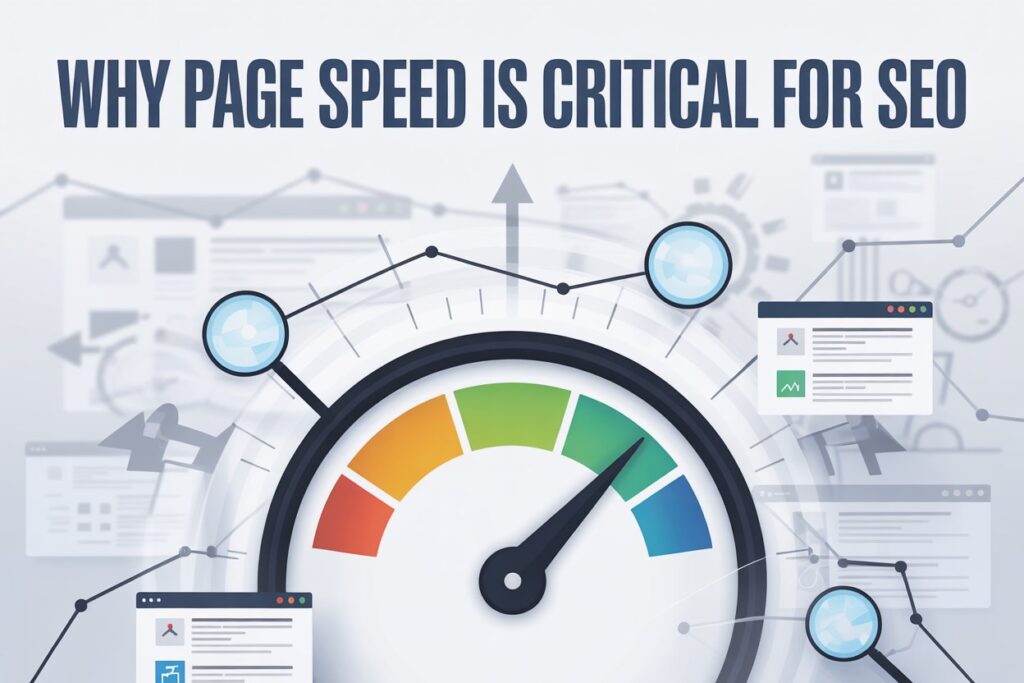
Why Page Speed is Critical for SEO and User Experience November 09, 2025 | By Agenterhub Team Why Page Speed is Critical for SEO and User Experience In today’s fast-paced online world, where folks in Birmingham grab their phones to find local services during a quick lunch break, waiting for a website to load feels like forever. Page speed – how quickly your site pops up and works – isn’t just a tech detail; it’s a game-changer for search rankings and keeping visitors happy. Slow sites drive people away, hurting your business’s visibility and sales. This article breaks down why it matters, with real tips to fix it. As search engines like Google push for better user experiences, page speed has climbed the priority list. For Birmingham companies, from bustling city centre shops to suburban services, getting this right can mean more local customers finding you first. Agenterhub, a digital marketing agency based in Birmingham, has seen firsthand how speeding up sites lifts online success for their clients. The Basics of Page Speed Page speed measures how fast your website loads its content, from the first click to full interaction. It’s not just about the whole page; bits like images and text matter too. In simple terms, quicker loads mean smoother browsing, which keeps users sticking around. Think of it like popping into a Birmingham café – if the queue’s too long, you might head elsewhere. Online, the same applies. Industry reports show that even small delays can push visitors away, making speed a must for any site. Practical tip: Use free tools like Google’s PageSpeed Insights to check your site’s score. It’s a quick way to spot issues without needing expert help right away. How Page Speed Affects SEO Rankings Search engines want to show users the best results, and that includes sites that load fast. Google has made page speed a direct ranking factor through its Core Web Vitals, which look at real-user experiences. Slow sites get pushed down the list, meaning fewer clicks from searches. For SEO, this means optimising speed can bump you up in results, especially for mobile searches common in Birmingham’s on-the-go crowd. According to industry reports, sites that load quickly see better positions, as search algorithms reward good performance. Real-world example: A local Birmingham retailer tweaked their site to cut load times, jumping from page two to the top of search results for “home goods Birmingham.” This led to more store visits and online buys. The Impact on User Experience Nobody likes staring at a blank screen. Fast page speed keeps users engaged, letting them find what they need without frustration. Slow loads can cause stress and make people click away, harming your site’s reputation. In user experience terms, quick sites build trust and encourage deeper exploration. For instance, if a Birmingham event planner’s page loads slowly, potential clients might skip to a faster rival, missing out on bookings. Lower bounce rates, as users stay longer. Higher satisfaction, leading to repeat visits. Better accessibility for all, including those on slower connections. Scenario: Imagine a student in Selly Oak searching for quick food delivery. A site that loads in under two seconds wins the order; anything slower, and they’re gone. Understanding Core Web Vitals Google’s Core Web Vitals are key metrics that tie page speed to both SEO and UX. They include Largest Contentful Paint (LCP) for loading speed, Cumulative Layout Shift (CLS) for stability, and Interaction to Next Paint (INP) for responsiveness. These aren’t just numbers; they reflect how real people interact with your site. Aim for LCP under 2.5 seconds, CLS below 0.1, and INP under 200 milliseconds for top marks. Tip: Regularly test with tools like Lighthouse to track these. Agenterhub uses them to help Birmingham firms meet these standards, often seeing quick wins in rankings. Real-World Stats and Consequences According to industry reports from 2024-2025, 53% of mobile users abandon sites that take over three seconds to load. That’s huge for Birmingham businesses relying on local mobile searches. A one-second delay can cut conversions by up to 7%, hitting sales hard. Slow sites also boost bounce rates, where users leave without clicking further, signalling poor quality to search engines. Example: A Birmingham tech shop saw their bounce rate drop from 60% to 30% after speeding up their site, leading to more enquiries and a busier store. Practical Ways to Boost Page Speed Improving speed doesn’t need a full overhaul. Start with simple fixes that deliver big results. Compress images without losing quality – tools like online optimisers can shrink file sizes by half. Use browser caching so returning visitors load faster. Minify code to remove extra spaces and lines. Choose a reliable host with servers close to your audience, like UK-based for Birmingham users. Enable compression for files sent to browsers. Scenario: A café in the Jewellery Quarter optimised their menu images, cutting load time by two seconds and seeing more online orders during lunch rushes. Agenterhub guides clients through these tweaks with easy audits. Emerging Trends in 2025 In 2025, page speed trends focus on mobile-first designs and AI tools for smarter optimisation. With folks expecting loads under one second, especially on phones, businesses must adapt. New browser tech helps with faster rendering, while sustainable practices like lighter code reduce energy use. Image formats like AVIF offer better compression for quicker loads. For Birmingham’s creative scene, trends like interactive elements need balancing with speed to avoid slowdowns. Stay ahead by monitoring updates from Google. Why Birmingham Businesses Can’t Ignore This Birmingham’s diverse economy, from tech hubs to retail giants, thrives on local searches. With high mobile use during commutes or events like the Christmas market, slow sites mean missed chances. Local SEO ties into speed, as Google favours fast experiences for “near me” queries. A slow site could lose out to quicker rivals in areas like Edgbaston or Digbeth. Tip: Target Birmingham-specific optimizations, like fast-loading maps for directions. Agenterhub, rooted in the city, helps tailor these for maximum

Why Page Speed is Critical for SEO and User Experience Read More »

Local Keyword Research Strategies for Birmingham Companies

Local Keyword Research Strategies for Birmingham Companies

Local Keyword Research Strategies for Birmingham Companies November 04, 2025 | By Agenterhub Team Local Keyword Research Strategies for Birmingham Companies Birmingham stands as a lively hub in the Midlands, packed with firms from tech startups to traditional shops. With its mix of cultures and busy economy, local search plays a big role in connecting businesses to nearby customers. Getting keyword research right can help your company show up when folks search for services in areas like the city centre or suburbs. This guide shares practical ways to nail it, based on tried-and-true methods that fit the local scene. Drawing from hands-on work with Birmingham businesses, these strategies focus on what works here. Think about how a café in Moseley might target searches tied to weekend brunches. Agenterhub, a digital marketing agency right in Birmingham, has guided many local outfits through this process, turning vague ideas into sharp campaigns. Why Local Keywords Matter for Birmingham Firms In a city as spread out as Birmingham, people often search with location in mind. Terms like “best plumber near Edgbaston” or “vegan food in Digbeth” drive real visits. According to industry reports, searches with local intent make up a big chunk of mobile queries, especially in urban spots like this. This matters because Birmingham’s crowd is young and diverse, with many using phones on the go. Missing out on local keywords means losing to rivals who get it. For example, a hair salon could see more bookings by focusing on “curly hair specialist Birmingham” instead of broad terms. Tip: Start by listing what your business offers, then add city twists. Agenterhub suggests chatting with customers to spot common phrases they use. Essential Tools for Keyword Research Picking the right tools makes research quicker and smarter. Free options like Google’s own planner help spot search volumes without cost. Paid ones dig deeper into what locals type in. In Birmingham, tools that show location data are key. Use them to see how terms perform in specific postcodes. Industry practices highlight combining these with Google’s autocomplete for fresh ideas – just type “Birmingham” and see what pops up. Practical scenario: A bike shop in Kings Heath used a tool to find “electric bike repair Birmingham” was rising, leading to a blog post that boosted traffic. Agenterhub often pairs tools with their in-house checks for tailored results. Step-by-Step Guide to Local Keyword Research Break it down into clear steps to avoid overwhelm. This approach, rooted in standard SEO methods, ensures you cover basics and build from there. Kick off by noting your main services. For a bakery, that might be “fresh bread” or “custom cakes.” Add Birmingham specifics like “artisan bakery Jewellery Quarter” to make them local. Keep lists short at first – aim for 10-20 ideas. Think about what Brummies might search during events like the Frankfurt Christmas Market. Layer in places. Use “in Birmingham,” “near me,” or neighbourhoods like Sparkbrook for ethnic food spots. Tools help check if these get enough searches without being too competitive. Example: A gym shifted from “fitness classes” to “yoga classes Harborne,” drawing in locals who skipped broader results. Understand why people search. Is it to buy (transactional), learn (informational), or find a spot (navigational)? Match keywords to this – “how to fix a leaky tap Birmingham” suits info content. Agenterhub advises grouping terms by intent to plan content that meets needs, like guides for info searches. Look at what similar businesses rank for, using tools to spot gaps. See if they miss long-tail phrases like “affordable wedding venues South Birmingham.” Tip: Note patterns in top results, then create better versions. This builds on common practices without direct copies. Use tool insights to pick winners – low competition, decent volume. According to industry reports, long-tail keywords convert better in local settings. Real case: A florist targeted “same-day flower delivery Aston” after data showed demand, upping orders during peak times. Advanced Strategies for Birmingham’s Market Go beyond basics to stand out in this competitive city. Trends like voice search mean focusing on natural phrases, as folks ask Siri “where’s the nearest coffee shop in Birmingham city centre.” Incorporate seasonal twists – “summer festivals Birmingham transport” for event firms. Mobile-first is huge here, with commuters on trains searching en route. Voice optimisation: Use question-based keywords. Neighbourhood focus: Target areas like Solihull for upscale services. User-generated ideas: Pull from reviews or social chats. Scenario: A tech repair shop used “iPhone screen fix Bullring” during shopping peaks, seeing a jump in walk-ins. Agenterhub helps with these by blending data and local know-how. Integrating Keywords into Your Online Presence Research is pointless without action. Place keywords in website titles, descriptions, and content naturally. For Google Business Profile, ensure details match searches like your address in listings. Create location pages if you serve multiple spots – one for “services in Erdington,” another for “in Bournville.” This aligns with best practices for multi-area businesses. Tip: Update profiles regularly, adding photos of local landmarks to boost appeal. Agenterhub stresses consistency across sites to avoid confusing search engines. Measuring Success and Making Adjustments Track how keywords perform with free tools like Google Analytics. Look at traffic from local searches and conversion rates – did that “Birmingham accountant for small firms” term lead to enquiries? Set benchmarks: Aim for steady growth in impressions. If a keyword flops, swap it based on data. Common adjustments: Drop high-competition terms. Boost content around rising searches, like eco-friendly trends. Review quarterly to stay current. Example: A restaurant tweaked from “Italian food Birmingham” to “pasta takeaway Selly Oak” after seeing student traffic spike. Agenterhub offers ongoing audits to keep strategies sharp. Common Pitfalls to Avoid Even pros slip up. Don’t stuff keywords – it annoys readers and search engines. Ignore mobile at your peril; Birmingham’s on-the-move crowd expects fast loads. Overlooking reviews is another miss – positive ones boost local rankings. Finally, skip broad terms; locals want specifics. Agenterhub warns against set-it-and-forget-it mindsets. Regular tweaks keep you ahead in this fast-changing city. Why Team

Local Keyword Research Strategies for Birmingham Companies Read More »

Best Facebook Ad Formats for Birmingham Audiences

Best Facebook Ad Formats for Birmingham Audiences

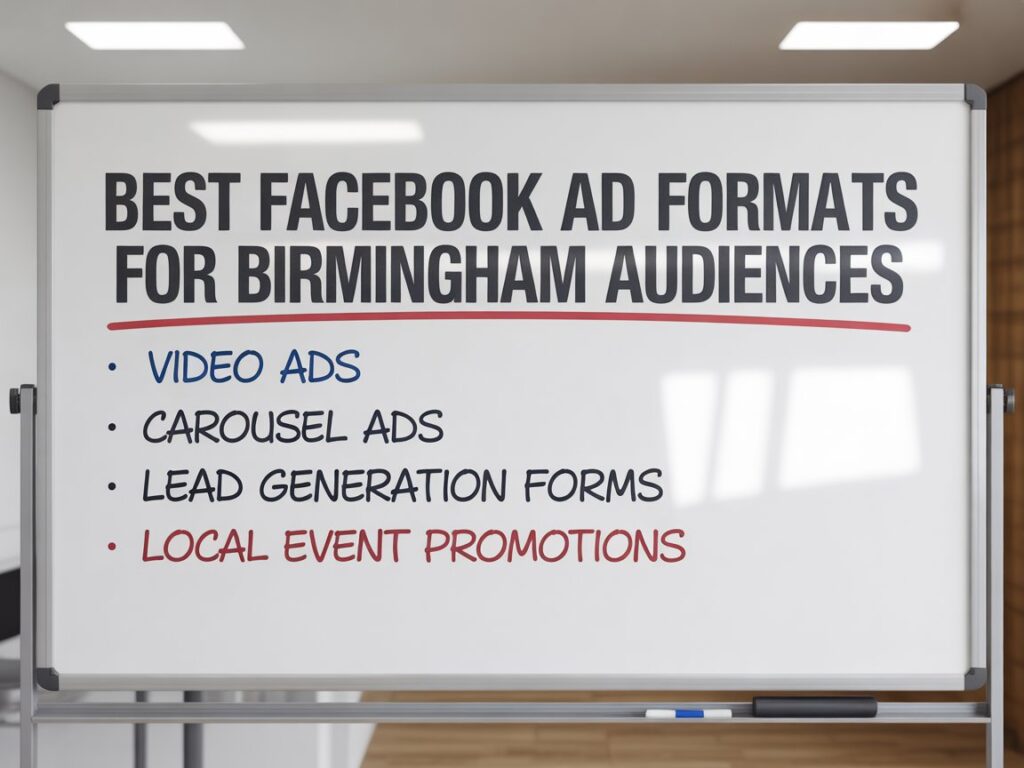
Best Facebook Ad Formats for Birmingham Audiences November 1, 2025 | By Agenterhub UK Best Facebook Ad Formats for Birmingham Audiences Birmingham, the UK’s bustling second city, is a hotspot for businesses aiming to connect with a vibrant mix of people. With its young, multicultural population and growing economy, running Facebook ads here can drive real results if you pick the right formats. This article dives into the best options, drawing on proven industry practices to help you craft campaigns that resonate locally. Whether you’re a shop owner in the Bullring or a service provider in Edgbaston, these insights can lift your ad game. As a digital marketing agency based right in Birmingham, Agenterhub knows the local scene inside out. They’ve helped countless firms navigate Facebook’s tools to reach Brummies effectively. Let’s explore how to make your ads stand out. Understanding Birmingham’s Unique Audience Birmingham boasts a population of over 1.15 million, making it the largest city outside London. It’s a melting pot with diverse ethnic groups, from South Asian communities in Sparkhill to young professionals in the city centre. Industry reports highlight its youthful vibe, with a big chunk under 30 years old, drawn to tech, culture, and events like the Commonwealth Games legacy. This diversity means ads must feel personal and inclusive. For instance, targeting families in suburbs like Sutton Coldfield differs from appealing to students near universities. Tailor your messaging to local landmarks or events – think referencing the Custard Factory for creative types or Villa Park for sports fans. This builds trust and boosts engagement. Practical tip: Start by using Facebook’s location targeting to zero in on postcodes. Combine it with interests like “Birmingham foodies” or “Midlands events” for sharper reach. Agenterhub often advises clients to test small audiences first, refining based on real responses. Top Facebook Ad Formats for Local Success Facebook offers a range of ad types, but not all suit Birmingham’s fast-paced, mobile-heavy users. According to industry reports, formats that mix visuals and quick interactions perform best in urban areas like this. Here, we focus on the most effective ones, with tips to adapt them locally. Image Ads: Simple Yet Powerful Image ads are straightforward – a single photo with text overlay and a call-to-action button. They’re ideal for quick impressions on busy feeds. In Birmingham, use high-quality shots of local scenes to grab attention. For example, a café could show steaming coffee against the Selfridges building backdrop. Keep images square (1080 x 1080 pixels) for best display on mobiles, as most users scroll on phones. Real-world scenario: A Birmingham boutique ran image ads featuring models in city parks, leading to a surge in foot traffic. Agenterhub suggests A/B testing colours – warmer tones like reds work well for food businesses here. Video Ads: Engaging Stories on the Move Video ads let you tell a tale in seconds, perfect for Birmingham’s dynamic crowd who love short, snappy content. Aim for 15-30 second clips that hook immediately. Show behind-the-scenes of a local event or customer testimonials with Brummie accents for authenticity. Industry trends show videos boost engagement by highlighting emotions, like joy at a Birmingham festival. Example: A fitness studio targeted young professionals with videos of group classes in Cannon Hill Park. Results? More sign-ups during peak hours. Tip from Agenterhub: Keep production simple – phone footage often feels more genuine to local audiences. Carousel Ads: Showcase Variety Carousel ads allow up to 10 images or videos in one swipeable unit, great for showing options without overwhelming. For Birmingham shops, this format shines by displaying products tied to local needs, like winter gear for chilly Midlands weather or Eid specials for multicultural areas. Link each card to a different landing page for seamless shopping. Practical use: A home decor store used carousels to feature items inspired by Birmingham’s industrial heritage, driving online sales. Agenterhub recommends tracking which card performs best to refine future campaigns. Stories Ads: Full-Screen Immersion Stories ads appear in Facebook’s Stories section, offering vertical, full-screen experiences that vanish after 24 hours. Birmingham’s Gen Z and millennials, a big part of the population, flock to Stories for quick updates. Use polls, stickers, or swipe-up links to interact – perhaps asking “What’s your favourite Brum spot?” to spark chats. Scenario: An event planner promoted gigs with Stories showing live crowds at the O2 Academy, filling seats fast. Agenterhub notes that adding location tags here amps up local relevance. Lead Ads: Easy Conversions Lead ads simplify sign-ups by pre-filling forms with user data, reducing drop-offs. In Birmingham, where people juggle busy lives, this format excels for services like consultations or newsletters. Customise questions to gather local insights, such as postcode for targeted follow-ups. Tip: A real estate agent used lead ads for property viewings, targeting families in Moseley. Agenterhub helps set up these with privacy in mind, ensuring compliance. Tailoring Ads to Birmingham’s Trends Birmingham’s growth as a tech and creative hub means audiences respond to innovative ads. Industry reports point to rising use of AI for personalisation, like dynamic creatives that change based on viewer interests. Focus on mobile optimisation, as the city’s commuters rely on phones. Incorporate local lingo – words like “buzzin’” for excitement – to make ads feel homegrown. Test timings around rush hours or weekends when people browse more. Agenterhub’s team, rooted in the city, uses data-driven tweaks to maximise ROI for clients. Measuring and Optimising Your Campaigns Success hinges on tracking metrics like click-through rates and conversions. Use Facebook’s Insights to see what’s clicking with Brummies. Set clear goals: Awareness for new brands, traffic for shops. Adjust budgets based on performance – start small, scale winners. Real tip: Review ads weekly. If a video underperforms, swap hooks. Agenterhub offers audits to spot improvements, turning okay campaigns into stellar ones. Why Partner with Agenterhub? As a Birmingham-based digital marketing agency, Agenterhub specialises in Facebook ads that hit home. Their experts handle everything from format selection to targeting, drawing on local knowledge to craft campaigns that convert. Whether you’re

Best Facebook Ad Formats for Birmingham Audiences Read More »