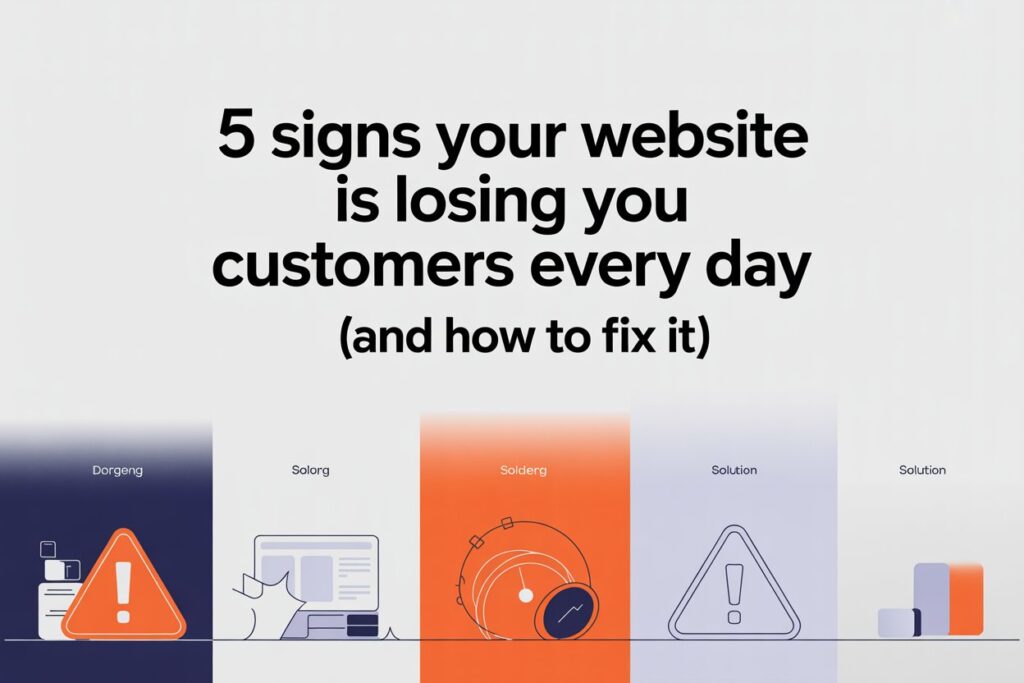
5 Signs Your Website Is Secretly Losing You Customers Every Single Day
Most business owners think of their website as a digital brochure. You build it once, it exists, and it does its job by simply being there. The reality in 2026 is very different. Your website is either your best salesperson or your worst liability. There is very little middle ground.
The uncomfortable truth is that a poorly performing website does not just fail to win customers. It actively sends them to your competitor. Someone lands on your page, something frustrates them within a few seconds, and they leave. They do not email you to explain why. They do not call to say they had a bad experience. They just go. And they usually end up somewhere else.
Here are the five signs that your website is doing this to you right now, and what to do about each one.
Sign 1: Your Website Takes More Than Three Seconds to Load
Three seconds sounds like nothing. But in the context of online behaviour it is an eternity. Research consistently shows that over half of all website visitors will leave a page if it has not loaded within three seconds. On mobile that number is even higher.
Every second of load time that you remove translates directly into a higher percentage of visitors who stay on your page instead of bouncing straight back to Google. That means more leads, more enquiries and more revenue from exactly the same number of visitors.
Slow load times are usually caused by images that have not been compressed, too many plugins running on a WordPress site, poor quality hosting, or code that has not been optimised. All of these are fixable.
Nabeel from Agenterhub UK checks page speed as the very first step on every website audit: “It does not matter how good your content is or how much you have spent on design if the page loads in seven seconds. Google uses load speed as a ranking factor and visitors use it as a trust signal. A slow website says something unflattering about the business behind it, even if that is completely unfair.”
You can test your own website speed right now using Google PageSpeed Insights. If your mobile score is below 60, this is your most urgent problem to fix.
Sign 2: Your Website Does Not Work Properly on Mobile
This one still surprises people. In 2026 the majority of website traffic comes from mobile devices. Across most industries in the UK, mobile accounts for between 55% and 70% of all visits. If your website was built more than four years ago without a specific focus on mobile experience, there is a strong chance it is broken for more than half the people visiting it.
Mobile problems range from obvious to subtle. Text that is too small to read without zooming. Buttons that are too close together to tap accurately. Images that spill off the side of the screen. Forms that do not work when filled in on a phone. Phone numbers that are not clickable to call directly.
Every one of these friction points is a reason for a visitor to leave. And visitors who leave because of a bad mobile experience rarely come back.
Juned Ali at Agenterhub UK sees this regularly across new client websites: “We will audit a site and find that on desktop it looks completely fine. Clean, professional, well laid out. Then we switch to mobile view and it falls apart. Menus that do not open, text sitting on top of images, a contact form with fields that are impossible to fill in on a touchscreen. That business has been losing mobile customers silently for years without even knowing it.”
Sign 3: There Is No Clear Call to Action Above the Fold
Above the fold means the part of the page a visitor sees without scrolling. It is prime real estate and most websites waste it completely.
A visitor arrives at your website with a problem they want solved. They have approximately five to eight seconds to decide whether they are in the right place and what to do next. If your page does not clearly tell them what you do, who you do it for and what they should do next all within that visible area, you have lost them.
A clear call to action does not need to be complicated. A visible phone number. A button that says “Get a free quote today.” A simple form with two fields. Something that gives the visitor an obvious frictionless next step without requiring them to scroll, search or think.
Look at your homepage right now on your phone without scrolling. Is it completely obvious what your business does and how to contact you? If you have to scroll to find the answer, that is a conversion problem.
Sign 4: There Are No Trust Signals Anywhere to Be Seen
When someone visits your website who has never heard of you before, they are making a rapid unconscious assessment of whether you are trustworthy. This happens in seconds and it happens before they have read a single word of your content.
Trust signals are the elements that tip that assessment in your favour. Customer reviews and testimonials with real names and specific outcomes. Case studies showing actual results. An About page with real photographs of real people. Industry accreditations or memberships. A physical address and a local phone number. A clear privacy policy.
The absence of these signals does not make a visitor think neutrally about your business. It makes them feel uncertain and uncertainty sends people back to Google.
The businesses winning customers online in 2026 have made trust visible throughout their website. It is not buried on an inner page. It is woven into the homepage, the service pages and every touchpoint a visitor might land on.
Sign 5: Your Content Talks About You Instead of Your Customer
This is the most common website mistake and the hardest one for business owners to see objectively because it requires looking at your own business from the outside.
Read your homepage copy right now. Count how many times it says “we” and how many times it describes the customer’s problem or outcome. In most cases the ratio heavily favours “we.”
“We have been trading since 2008. We offer a comprehensive range of services. We are committed to quality.”
None of that tells a potential customer anything about what is in it for them. It does not address their problem. It does not speak to their situation. It does not make them feel understood. And people only buy from businesses that make them feel understood.
The fix is to rewrite your content starting from the customer’s perspective. What problem are they arriving with? What outcome are they hoping for? What do they need to feel confident enough to get in touch? Answer those questions on the page and your conversion rate will improve without changing a single other thing.
What to Do Right Now
If you recognised your website in any of these five signs, you are not alone. The majority of small business websites in the UK have at least two or three of these problems and most business owners have no idea because the website looks fine to them when they view it on their office desktop.
The real cost of these problems is not a one-off incident. It is every visitor who left without enquiring, multiplied across every day the site has been live in its current state.
Agenterhub UK offers a free website and digital marketing audit that identifies every one of these issues, prioritises them by impact and gives you a clear action plan for fixing them. Juned Ali and the team will review your site, your speed, your mobile experience, your conversion elements and your content and give you honest feedback with no obligation attached.
Book your free audit at agenterhub.uk and find out exactly what your website is costing you right now.
Agenterhub UK serves businesses across Derby, Derbyshire, Birmingham, Scunthorpe and Tunbridge Wells.